Experience, Balance, and Adaptation: The New National Championship Formula
The 2025 college football season has come to a close, and there’s a new king atop the sport. The Indiana Hoosiers have captured the National Championship. Long known for its dominance, the SEC’s grip on the title is beginning to loosen as the Big Ten claims its third consecutive championship. A new blueprint for winning it all is emerging, and these programs have embraced it. With the expanded College Football Playoff now in place, true parity is taking hold, and we are witnessing a different era of college football.
Roster construction is vital in the offseason as the teams with the most talented players are no longer dominating like they used to. The previous champions have found a different strategy on roster building and have been successful as of late. As college football continues to change, programs must adapt in order to reach their goals.
Experience
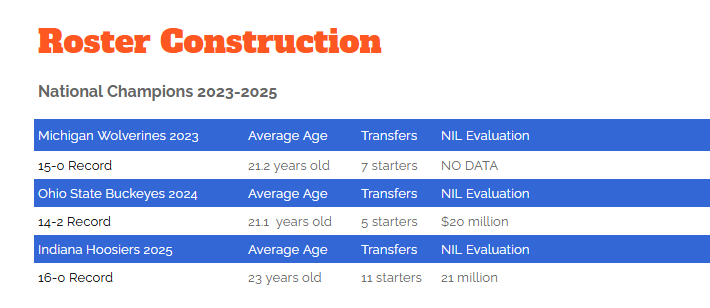
The chart shows the average age of players on the last three national championship teams. Each of these programs successfully assembled rosters of older, more experienced players. Having a more experienced roster provides a clear advantage, as player development is a major factor in sustained success. In the expanded playoff, highly talented teams have recently struggled against more mature opponents, as experienced players are less prone to costly mistakes. Experience on a roster is especially valuable when players have prior playoff experience; all three of these teams had multiple starters with such experience. This also enhances team leadership, as players can rely on each other’s past experiences to achieve success. Coaches with playoff experience further contribute to team performance, particularly in the expanded format. Many coaches across the country have noted the difficulty of keeping teams prepared after a long layoff, but championship-winning coaches have learned to overcome these challenges through effective game plans, strategies, and preparation during extended breaks between games.
Transfer Portal Additions
As we know, teams have been able to recruit from the transfer portal to assemble a roster. However, this strategy is not always effective, as success depends on achieving the right blend of returning players and new additions. These champions have used the transfer portal efficiently by recruiting players to address specific positional needs. They have been supplementing parts of their rosters with experienced athletes who can help contribute immediately.
NIL Priorities
The NIL has changed the landscape of college football and teams are learning to adapt. In order to succeed in this new landscape, teams will have to prioritize the use of NIL spending. Most successful programs have used NIL resources to retain experienced players on their rosters while also securing key additions through the transfer portal. NIL-driven high school recruiting has become less effective unless recruits are able to contribute meaningful playing time early. If young players recruited out of high school don’t receive meaningful playing time, they are likely gone by the next season. This blueprint suggests that teams should address positional needs through the transfer portal and offer NIL incentives to experienced players rather than to unproven newcomers.
Balanced Team
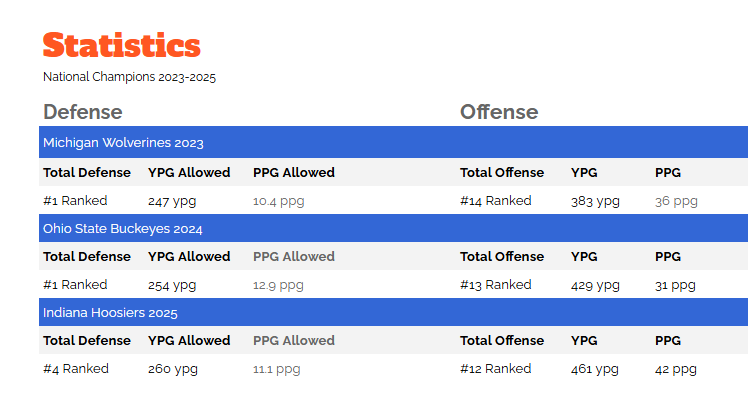
Other than roster construction, the previous champions have had nearly identical statistics in their championship seasons. The saying “defense wins championships” has proven true over the past few years, as each of these teams has ranked among the top five defenses in the country. Having a top defense is especially advantageous in college football, as offenses are generally less complex than at the professional level. It also allows your offense to develop throughout the season as programs will rely on their defenses when the offense struggles. Their offensive stats are strong, reflecting the necessity of a capable offense to contend for national titles. In the playoffs, offenses must perform at their peak, as defenses often determine the outcome of games. The importance of having a balanced team on both sides of the ball has led to championships. As college football evolves with older players staying in the sport longer, maintaining the right balance on a roster has become critical to success.
Schedule Management
Depth is important in the playoffs as teams go through injuries. In this era of college football it is very difficult to field a team with strong depth players as they likely transfer to other schools. Although teams are struggling to field talented depth players it is apparent that coaches manage the games properly to get young players more reps. Giving younger players reps during the season will be vital as injuries happen throughout the playoffs. Also, giving some playing time can help with transfer issues as players may be more apt to stay if they receive some valuable reps.